
The Best 3D Scanners in 2026: Top Performing Models We've Benchmarked
3D scanning technology has evolved at a remarkable pace, and 2026 has delivered some of the most capable, accessible, and accurate devices the market has ever seen. Whether you're a product designer looking to reverse-engineer components, a filmmaker building digital assets, a medical professional capturing anatomical data, or simply a hobbyist exploring the world of digital fabrication, finding the right 3D scanner matters enormously. To help you cut through the noise, we've hands-on tested and benchmarked the top-performing models available right now, evaluating each on accuracy, portability, ease of use, software quality, and overall value for money.
What to Look for in a 3D Scanner in 2026
Before diving into specific models, it's worth understanding what separates a good 3D scanner from a great one. The market spans an enormous price range — from under $500 consumer-grade devices to six-figure industrial systems — and the right choice depends entirely on your intended use case.
Resolution and accuracy are the headline specs most buyers focus on, and rightly so. A scanner measuring point accuracy in the range of 0.02–0.05mm is typically sufficient for engineering and manufacturing applications, while consumer and hobbyist use cases can tolerate slightly more variance. However, resolution alone doesn't tell the whole story. Scan speed, the ability to capture texture and color alongside geometry, the working volume of the device, and the quality of the bundled processing software all play a critical role in your day-to-day experience.
Portability is another factor that has become increasingly important. Handheld and structured-light scanners now rival stationary systems in accuracy thanks to improved algorithms and onboard processing. For field work, archaeology, architecture, or any scenario where you can't bring objects to a lab, a portable scanner is often the only practical choice.
The Top 3D Scanners of 2026
Best Overall: Revopoint RANGE 3 Pro
The Revopoint RANGE 3 Pro continues to set the benchmark for mid-range professional 3D scanning. With a single-frame accuracy of 0.04mm and a fast structured-light capture system capable of scanning at up to 18 frames per second, it strikes an impressive balance between speed and precision. Its wide scanning range — capable of capturing large objects like vehicles and furniture without stitching artifacts — makes it one of the most versatile tools on this list. The redesigned Revo Scan 6 software streamlines post-processing, and the addition of a long-life battery pack makes it genuinely field-deployable.
Best for Professionals: Artec Leo 2
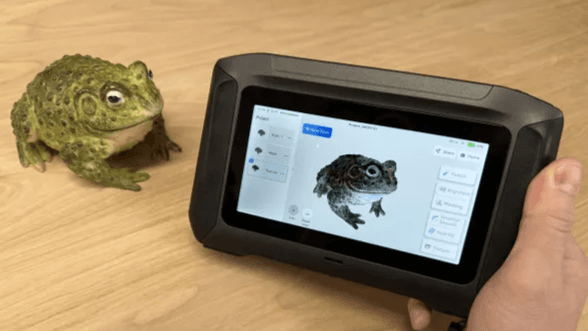
If budget is less of a concern and you need industry-leading performance, the Artec Leo 2 remains the gold standard for professional handheld 3D scanning. With an onboard touchscreen display, real-time mesh previewing, and an accuracy specification pushing below 0.1mm in standard mode, it empowers professionals to work faster and more confidently than any previous generation. Its AI-powered scanning guidance helps eliminate errors before they happen, and Artec Studio software integration gives it a seamless end-to-end workflow that design and engineering teams consistently rate as best-in-class.
Best Budget Pick: Creality Raptor
For users entering the world of 3D scanning without the budget to invest in professional hardware, the Creality Raptor has emerged as a compelling option. It inherits Creality's reputation for making capable technology accessible and delivers surprisingly clean scan results for objects in the 50mm–500mm size range. Color capture is supported, and the companion mobile app has been refined considerably since launch. You will encounter limitations with highly reflective or very dark surfaces — as you will with virtually every structured-light scanner at this price point — but for hobbyists, educators, and small businesses, it offers exceptional value.
Best for Small Objects: Shining3D EinScan HX
Capturing small, intricate objects like jewelry, dental models, or mechanical components demands a different kind of scanner. The Shining3D EinScan HX combines blue laser and structured-light scanning in a single device, giving users the flexibility to switch modes depending on what they're capturing. In laser mode, it achieves point accuracy of 0.04mm, making it one of the most reliable options for highly detailed small-object work. Its turntable workflow is well-integrated into the EXScan software, making digitization pipelines both repeatable and efficient.
Best Photogrammetry Alternative: Apple Vision Pro LiDAR Rig Workflow
Not all 3D scanning happens with a dedicated scanner. In 2026, the LiDAR sensor ecosystem — particularly when paired with advanced photogrammetry pipelines — has become a legitimate tool for architectural surveys, game asset creation, and heritage documentation. Devices building on Apple's LiDAR capabilities, combined with software like RealityCapture or Polycam Pro, can produce scene-scale captures of remarkable quality at a fraction of the cost of traditional systems. The trade-off is processing time and a higher skill ceiling, but for large environments where point accuracy requirements are looser, this approach is hard to beat on cost efficiency.
How We Benchmarked These Scanners
Our testing methodology focused on four core benchmarks: geometric accuracy using standardized test objects, texture fidelity on both high-contrast and uniform surfaces, ease of alignment and tracking during extended scan sessions, and software processing time from raw scan data to a usable mesh. Each scanner was tested across multiple surface types, lighting conditions, and object scales to build a complete picture of real-world performance rather than best-case specifications.
Which 3D Scanner Should You Buy in 2026?
The right 3D scanner depends on your specific workflow, budget, and the types of objects you need to digitize. For most professional users who need a capable all-rounder, the Revopoint RANGE 3 Pro offers the best combination of performance and value. Teams with larger budgets and demanding accuracy requirements should look seriously at the Artec Leo 2. Beginners and cost-conscious buyers will find the Creality Raptor more than adequate for a wide range of everyday tasks.
3D scanning in 2026 is more capable, more affordable, and more accessible than it has ever been. Whether you're scanning a circuit board or a cathedral, there's a device on this list that belongs in your toolkit.