
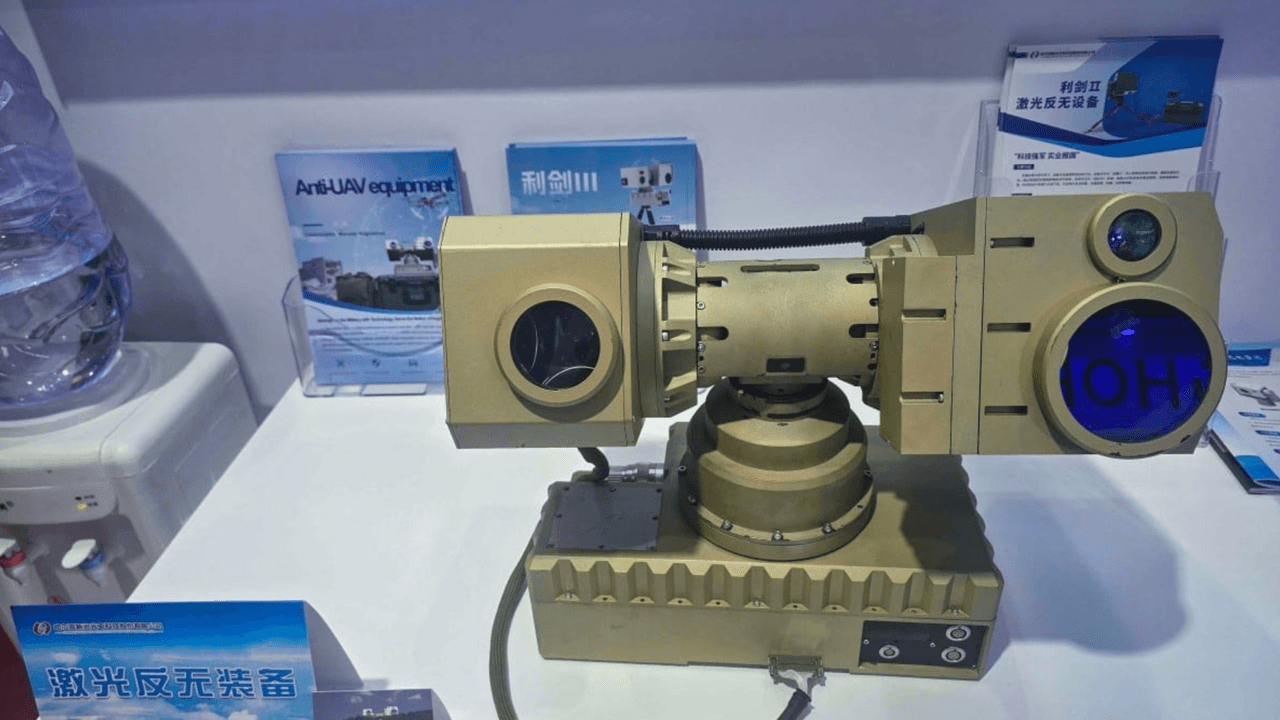
China Unveils a Game-Changing Man-Portable Anti-Drone Laser
The battlefield is evolving faster than at any point in modern military history, and drones are at the center of that transformation. From surveillance and reconnaissance to strike missions and swarm attacks, unmanned aerial vehicles have become one of the most disruptive forces in contemporary conflict. Now, China has responded to the drone threat with a weapon that sounds like it belongs in a science fiction film: a man-portable, backpack-sized 2-kilowatt laser system capable of burning through a drone at 1,600 feet in just four seconds — and it can be carried and operated by a single soldier.
This latest development from China's defense sector has drawn significant attention from military analysts, defense contractors, and governments around the world. It signals a major shift in how nations are approaching counter-drone warfare — moving away from expensive missile-based intercept systems toward more agile, cost-effective directed-energy solutions that can be deployed anywhere, by anyone on the ground.
What We Know About the System
The weapon system is compact by directed-energy standards, weighing in at approximately 55 pounds and designed to fit within a backpack-style carrying configuration. Despite its relatively modest size, the laser outputs 2 kilowatts of power — enough to disable, damage, or destroy a small-to-medium drone target at ranges of up to 1,600 feet (roughly 490 meters) within approximately four seconds of sustained beam contact.
One of the most significant features of the system is its integration of artificial intelligence for targeting. Rather than requiring a human operator to manually track and hold a laser beam on a fast-moving, potentially evasive drone target, the AI-assisted targeting system automates much of the acquisition and tracking process. This dramatically reduces operator workload and improves engagement speed and accuracy, especially against small drones that can be difficult to track with the naked eye.
Key Specifications at a Glance
- Output power: 2 kilowatts (2kW)
- Effective range: approximately 1,600 feet (490 meters)
- Time to neutralize target: approximately 4 seconds
- System weight: approximately 55 pounds (25 kilograms)
- Form factor: backpack-portable, operable by a single soldier
- Targeting: AI-assisted acquisition and tracking
Why Man-Portable Laser Weapons Matter Now
To understand the significance of this announcement, it helps to consider the broader context of modern drone warfare. The conflicts in Ukraine, the Middle East, and various regional disputes across Africa and Asia have demonstrated that cheap commercial and military drones are now a frontline threat. A single small drone carrying an explosive payload can disable a tank, kill soldiers in a trench, or destroy critical infrastructure — and they cost a fraction of the missiles traditionally used to shoot them down.
This creates a profound economic asymmetry problem. Intercepting a $500 commercial drone with a $100,000 surface-to-air missile is not a sustainable strategy at scale. Directed-energy weapons like lasers offer a compelling solution: once the system is built, each "shot" costs only the price of the electricity used to power the beam. Against high-volume drone swarm attacks in particular, this cost equation becomes even more favorable.
The man-portable dimension adds another critical advantage: flexibility. Traditional laser defense systems, such as those mounted on vehicles or naval vessels, require infrastructure and logistics that limit where they can be deployed. A 55-pound backpack system changes that calculus entirely. Infantry units, special operations forces, forward operating bases, and even civilian security teams could theoretically carry and deploy this kind of capability anywhere the mission demands.
The Role of AI in the Targeting System
Artificial intelligence is what makes this kind of compact directed-energy weapon viable in practice. Tracking a small, fast-moving drone with enough precision to maintain a focused laser beam on a specific point long enough to cause structural or thermal damage is extraordinarily challenging for a human operator alone. Wind, target maneuvers, atmospheric distortion, and parallax errors all introduce inaccuracy.
AI-powered targeting systems address these challenges by processing sensor data in real time, predicting target movement, compensating for environmental variables, and adjusting the beam continuously. The result is a dramatically more reliable engagement — one that doesn't depend on an operator's fatigue level, stress, or individual training. This also shortens the time from target detection to neutralization, which is critical when dealing with fast-moving threats or swarm scenarios involving multiple simultaneous targets.
Global Implications and the Counter-Drone Arms Race
China's unveiling of this system does not exist in a vacuum. The United States, Israel, the United Kingdom, and several other nations have been actively developing directed-energy counter-drone systems of their own, though most of these have been larger, vehicle-mounted platforms. The U.S. Army's SHORAD programs and Israel's Iron Beam system represent significant investments in laser-based defense, but man-portable implementations at this power level and price point remain a relatively frontier development.
China's announcement will almost certainly accelerate development timelines for competing nations. The ability to field a portable, AI-guided laser anti-drone weapon at the individual soldier level represents a meaningful tactical leap — one that could shift force structure planning, ROE (rules of engagement), and procurement priorities across multiple defense establishments worldwide.
What This Means for the Future of Warfare
The broader trajectory is clear: directed-energy weapons are moving from the laboratory and the naval deck to the infantry squad. As battery technology improves, laser efficiency increases, and AI targeting becomes more sophisticated, systems like China's 2kW backpack laser will become lighter, more powerful, and more accessible. The era of the personal directed-energy weapon — once a staple of science fiction — is arriving faster than most predicted.
For military planners, defense policymakers, and anyone tracking the evolving nature of conflict, China's man-portable anti-drone laser is not just a notable piece of hardware. It is a signal that the ground-level counter-drone problem is being solved — and the solutions are becoming small enough to carry on your back.