
A Race Against Gravity: NASA's Most Ambitious Satellite Rescue Mission
Space exploration is no stranger to audacious plans, but even by NASA's standards, what the agency proposed just ten months ago stands out as one of the boldest engineering challenges in recent memory. With a $500 million astronomy mission on the verge of crashing back to Earth, NASA turned to the private sector with an urgent question: can you build and launch a rescue satellite fast enough to save it? The answer, from a young startup called Katalyst Space Technologies, was a confident yes — and the clock immediately started ticking.
What Is the Swift Observatory and Why Does It Matter?
The Neil Gehrels Swift Observatory has been one of NASA's most productive space telescopes since its launch in 2004. Designed primarily to detect and study gamma-ray bursts — the most powerful explosions in the known universe — Swift has contributed to thousands of scientific publications and helped astronomers unlock some of the deepest mysteries of high-energy astrophysics. Its instruments can rapidly swivel to observe cosmic events within seconds of detection, making it a uniquely valuable tool that no other operational spacecraft can fully replace.
The problem is that Swift's orbit has been gradually decaying. Without a propulsion system capable of maintaining its altitude, the observatory is slowly being pulled toward Earth's atmosphere. Left unaddressed, this orbital decay would eventually result in an uncontrolled reentry, destroying the telescope and ending its scientific mission permanently. The price tag of the spacecraft and its contributions to science made allowing that outcome essentially unthinkable for NASA's astrophysics community.
NASA's Unusual Challenge to the Private Sector
In August of last year, NASA's astrophysics division took the unusual step of directly asking three companies whether they could solve this problem — fast. The ask was unprecedented: design, build, test, and launch a satellite capable of chasing down Swift, physically latching onto it, and boosting it back to a safe operating altitude, all within less than a year and on a tight budget.
Shawn Domagal-Goldman, director of NASA's astrophysics division, described the moment the winning proposal came back: "They came back with a response that was technically and programmatically plausible, and then we were like, 'Yeah, let's do it.'" That winning response belonged to Katalyst Space Technologies, a startup founded as recently as 2020 and based in Tucson, Arizona. The following month, in September, NASA awarded Katalyst a $30 million contract to make it happen.
Meet the Link: Katalyst's Robotic Servicing Spacecraft
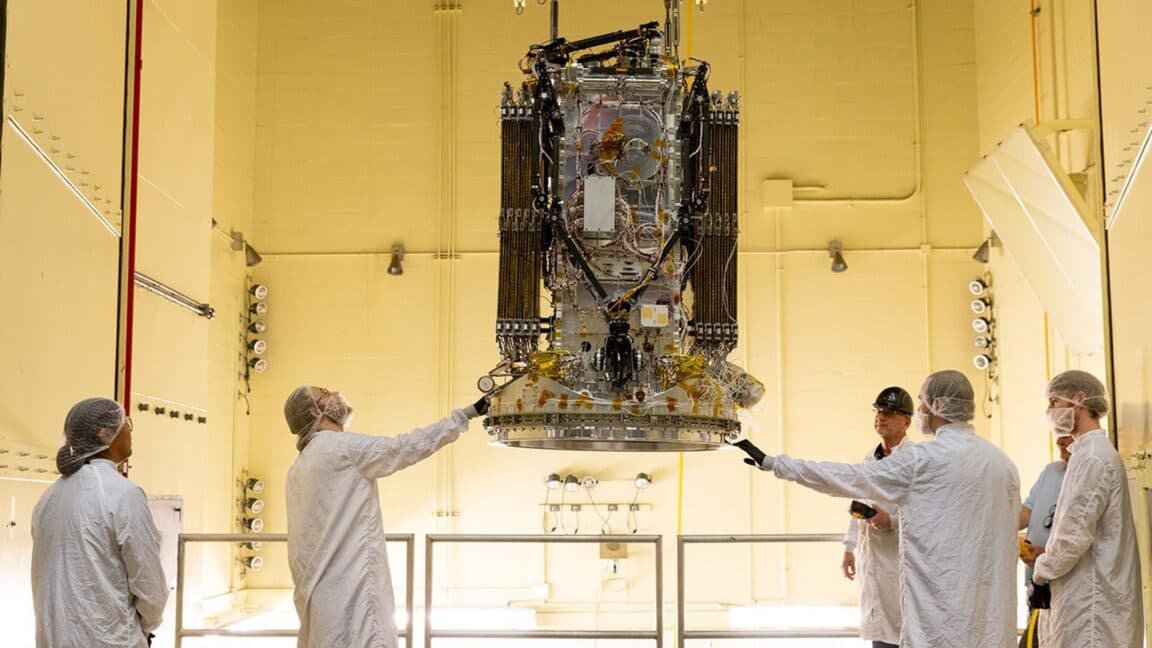
At the heart of the rescue mission is a small spacecraft called the Link, designed and built by Katalyst Space Technologies. What makes the Link remarkable is its proposed method of operation. Rather than simply docking with Swift using a standard interface — which the observatory was never designed to support — the Link will use three robotic arms to physically grab onto the telescope's exterior structure. This kind of autonomous grappling in deep space is something no commercial spacecraft has successfully accomplished before.
Once securely attached, the Link will fire its own propulsion system to gradually raise Swift's orbit back to a safe operational altitude. If successful, Swift will be able to resume its full scientific mission, potentially extending its useful life by years or even decades. The mission represents a new model for how NASA might think about preserving aging but scientifically invaluable assets already in orbit.
Why This Mission Is Harder Than It Sounds
While the concept is straightforward to describe, executing it is extraordinarily difficult. Several major technical and logistical hurdles stand between Katalyst and a successful rescue.
- Autonomous rendezvous and capture: The Link must locate, approach, and physically secure itself to a spacecraft that was never designed to be serviced on orbit. Any miscalculation during the grappling phase could damage Swift or send the servicing vehicle tumbling out of control.
- Timeline pressure: Ten months from contract award to launch is an almost unheard-of pace for a mission of this complexity. Traditional satellite development cycles often take years. Katalyst has had to compress every phase of design, integration, and testing simultaneously.
- Budget constraints: Thirty million dollars is a modest sum for a first-of-its-kind servicing mission. Every design decision has had to balance technical ambition with financial reality.
- Orbital mechanics: Precisely matching Swift's orbit, closing the distance safely, and executing a controlled boost maneuver all require flawless navigation and timing.
The Broader Implications for Satellite Servicing
Beyond the fate of Swift itself, the outcome of this mission carries enormous implications for the future of space infrastructure. Governments and commercial operators have billions of dollars' worth of satellites in orbit right now with limited or no ability to refuel, repair, or reposition them. If Katalyst can demonstrate that a small, affordable servicing spacecraft can be built quickly and deployed effectively, it could open the door to an entirely new commercial industry focused on on-orbit servicing.
NASA has been exploring in-space servicing concepts for years, but this mission — born out of necessity rather than a long development roadmap — could prove to be the breakthrough demonstration the industry needs. Several private companies and international space agencies are watching closely, and a successful outcome could accelerate investment and policy support for servicing infrastructure across the board.
What Happens Next?
As of mid-2025, Katalyst Space Technologies is deep in the final stages of preparing the Link spacecraft for launch from Wallops Island, Virginia. The launch window is tightly constrained by Swift's continuing orbital decay, meaning delays carry real consequences. Every week lost on the ground is a week in which the observatory drops slightly closer to the altitude at which rescue becomes impractical or impossible.
For the team at Katalyst, and for the scientists who have spent careers relying on Swift's data, the stakes could not be higher. This is not just an engineering challenge — it is a mission to preserve irreplaceable scientific capability and to prove that the era of routine satellite servicing may finally be within reach.
Conclusion: A New Chapter in Space Rescue
What started as an urgent phone call from NASA to three companies has rapidly evolved into one of the most watched space missions of 2025. Katalyst Space Technologies, a company barely five years old, has accepted a challenge that would daunt even the most established aerospace contractors. Whether the Link spacecraft succeeds or not, the mission has already demonstrated something important: with the right team, a clear problem, and a tight deadline, the pace of space innovation can surprise even the most seasoned observers. The world will be watching when the Link finally reaches Swift — and the outcome will help define how humanity cares for its most valuable assets in orbit for generations to come.