
Elon Musk and NASA's Chief Are Dreaming of Antimatter Propulsion — Here's What It Would Take
When two of the most influential figures in modern spaceflight start talking about the same radical technology, the world pays attention. Elon Musk, CEO of SpaceX, and NASA's chief have both publicly expressed fascination with antimatter propulsion — a concept that sounds ripped from the pages of science fiction but is rooted in very real physics. If humanity ever hopes to travel beyond our solar system and truly unlock the galaxy, antimatter propulsion may not just be an option. It may be the only option.
But what exactly is antimatter propulsion, why is it generating buzz at the highest levels of the space industry, and what would it actually take to make this theoretical dream a working reality? Let's break it down.
What Is Antimatter Propulsion?
To understand antimatter propulsion, you first need to understand antimatter itself. Every particle of ordinary matter has a corresponding antimatter counterpart with the same mass but opposite charge. For example, the antimatter equivalent of an electron is a positron. When matter and antimatter meet, they annihilate each other in a burst of pure energy — the most efficient energy release known to physics.
This is the core principle behind antimatter propulsion. Rather than burning chemical fuel or even harnessing nuclear fission, an antimatter engine would trigger controlled matter-antimatter annihilation reactions to generate thrust. The energy density of this process dwarfs every other propulsion method humans have ever conceived. A single gram of antimatter annihilating with a gram of matter would release energy equivalent to roughly 43 kilotons of TNT — comparable to a large nuclear weapon.
For spacecraft, this translates into the possibility of reaching a meaningful fraction of the speed of light, something that no existing or near-future propulsion system can come close to achieving.
Why Are Musk and NASA's Chief Talking About It Now?
The renewed interest from figures like Elon Musk and NASA leadership reflects a growing recognition that the next frontier of space exploration is not just Mars or the outer planets — it is the stars themselves. Proxima Centauri, our nearest stellar neighbor, sits about 4.24 light-years away. With current chemical rocket technology, a journey there would take tens of thousands of years. Even the most ambitious proposed concepts, like nuclear thermal propulsion, would barely make a dent in that timeline.
Antimatter propulsion, in theory, could reduce an interstellar voyage to decades rather than millennia. That is the kind of paradigm shift that captures the imagination of visionaries like Musk, who has repeatedly stated that making humanity a multi-planetary and ultimately multi-stellar species is one of his primary goals. For NASA, whose mission increasingly looks beyond the immediate solar system, antimatter represents a legitimate long-term research horizon worth funding and discussing at the highest levels.
The Physics Are Sound — The Engineering Is the Problem
Here is where the dream collides with harsh reality. The physics of antimatter annihilation are well-established and have been confirmed in laboratories like CERN. The problem is not theoretical — it is deeply practical, and the challenges stack up quickly.
Producing Antimatter at Scale
Currently, the world's most advanced particle physics facilities can produce only tiny quantities of antimatter, measured in nanograms at best. CERN's Antiproton Decelerator, one of the most capable antimatter production facilities on Earth, produces roughly 10 to 15 nanograms of antihydrogen per year. To fuel even a small antimatter-powered spacecraft on an interstellar mission, you would need grams or potentially kilograms of antimatter. The gap between current production capability and what is needed is astronomical — in the most literal sense.
Storing Antimatter Safely
Antimatter cannot touch ordinary matter without annihilating instantly, which means it cannot be stored in any conventional container. Researchers have developed magnetic confinement systems — known as Penning traps — that can suspend charged antimatter particles in a vacuum using electromagnetic fields. But these systems are energy-intensive, fragile, and capable of holding only microscopic amounts. Scaling this technology to store the quantities needed for spaceflight remains one of the most formidable engineering challenges in all of science.
The Cost Problem
Producing one gram of antimatter using current methods would cost an estimated $62.5 trillion dollars. That is not a typo. At that price point, even the wealthiest governments and corporations on Earth could not afford a meaningful supply. Dramatic breakthroughs in production efficiency — orders of magnitude beyond anything currently on the horizon — would be required before antimatter propulsion becomes economically viable.
Promising Research Directions
Despite these obstacles, scientists are not standing still. Several research directions offer genuine, if long-term, hope:
- Positron-powered propulsion: Some researchers have proposed using positrons (antielectrons) rather than antiprotons because they are easier to produce and store. While less energetic, positron-catalyzed reactions could still offer significant thrust improvements over chemical rockets.
- Penning trap miniaturization: NASA's Institute for Advanced Concepts has funded work on developing smaller, more efficient portable antimatter traps that could theoretically be carried aboard a spacecraft.
- Natural antimatter harvesting: Earth's magnetosphere actually traps small amounts of naturally occurring antimatter produced by cosmic ray interactions. Concepts for harvesting this antimatter in orbit have been explored, though quantities remain far too small for propulsion purposes today.
- Fusion-antimatter hybrid drives: Some proposals combine antimatter catalysis with nuclear fusion reactions, using tiny amounts of antimatter to trigger fusion events and dramatically increasing overall efficiency without requiring the enormous antimatter quantities a pure annihilation drive would need.
What Would a Working Antimatter Spacecraft Actually Look Like?
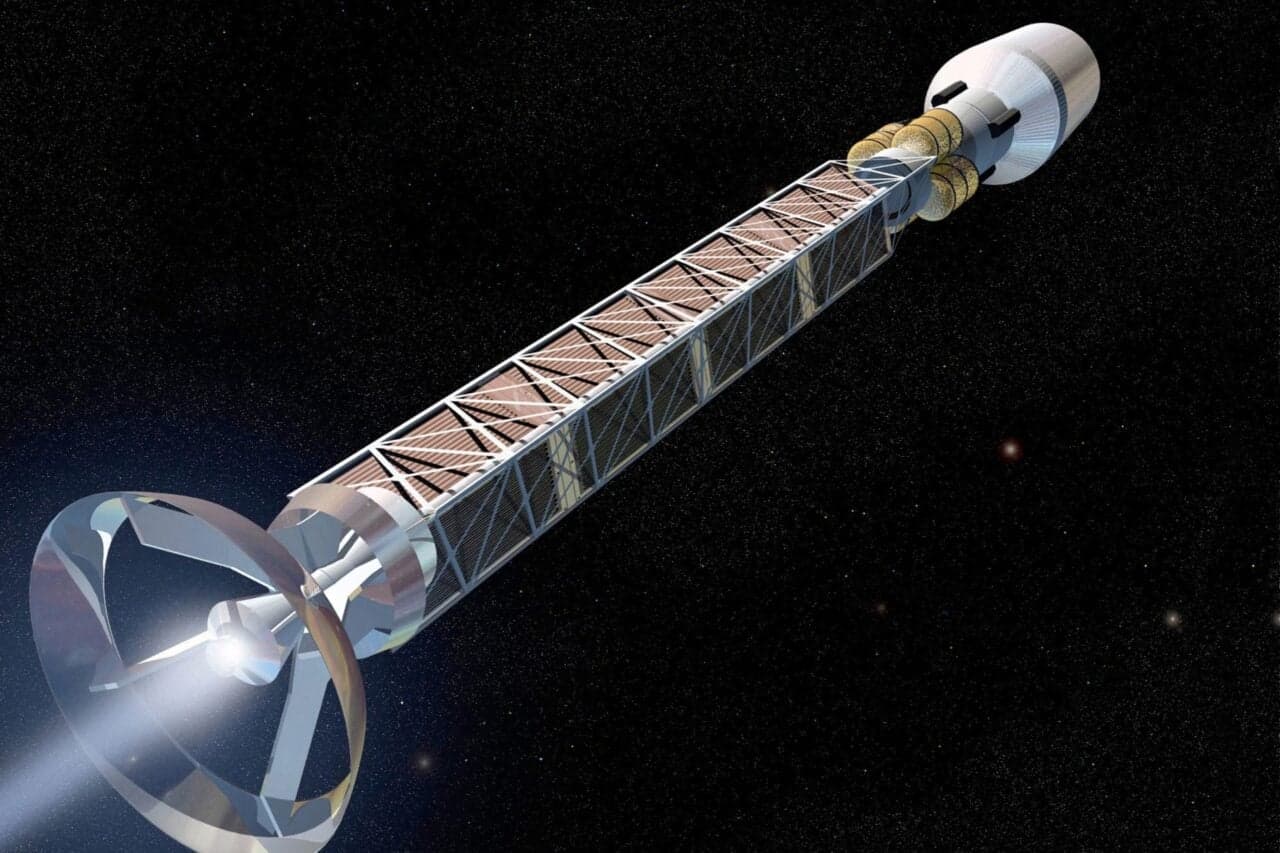
Conceptual designs for antimatter-powered spacecraft have emerged from NASA studies and academic institutions over the decades. One prominent concept, sometimes called the antimatter sail or beam-driven sail, uses a particle accelerator on Earth to fire a beam of antihydrogen atoms at a lightweight sail attached to a spacecraft, accelerating it to a fraction of light speed without carrying any propellant onboard. Other designs envision a magnetic nozzle that directs the gamma rays and charged particles produced by annihilation reactions to generate thrust directly.
None of these designs are buildable with today's technology. But they are not physically impossible, and that distinction matters enormously in the long arc of technological development.
The Bigger Picture: Why This Conversation Matters
The fact that leaders like Elon Musk and NASA's chief are openly discussing antimatter propulsion is itself significant. Throughout history, transformative technologies — from nuclear power to semiconductors to the internet — began as fringe theoretical conversations before becoming world-altering realities. Putting antimatter propulsion on the agenda at the highest levels of the space industry helps direct funding, inspire researchers, and signal to the broader scientific community that this is a serious long-term pursuit rather than idle speculation.
Unlocking the galaxy will not happen in the next decade, or even the next century, with current technology. But the journey of a thousand light-years begins with a single conversation — and that conversation is now happening at the very top.