
Amazon's Satellite Backlog Is Growing — And Europe Is Stepping Up
Amazon has a problem that sounds almost enviable: the company has built hundreds of satellites faster than it can launch them. Hundreds of flight-ready Project Kuiper satellites are currently sitting idle inside a payload processing facility in Florida, waiting for rockets to carry them into low-Earth orbit. According to Steve Metayer, Vice President of Amazon Leo Production Operations, the company is manufacturing several new satellites every single day, making the need for reliable launch vehicles more urgent than ever.
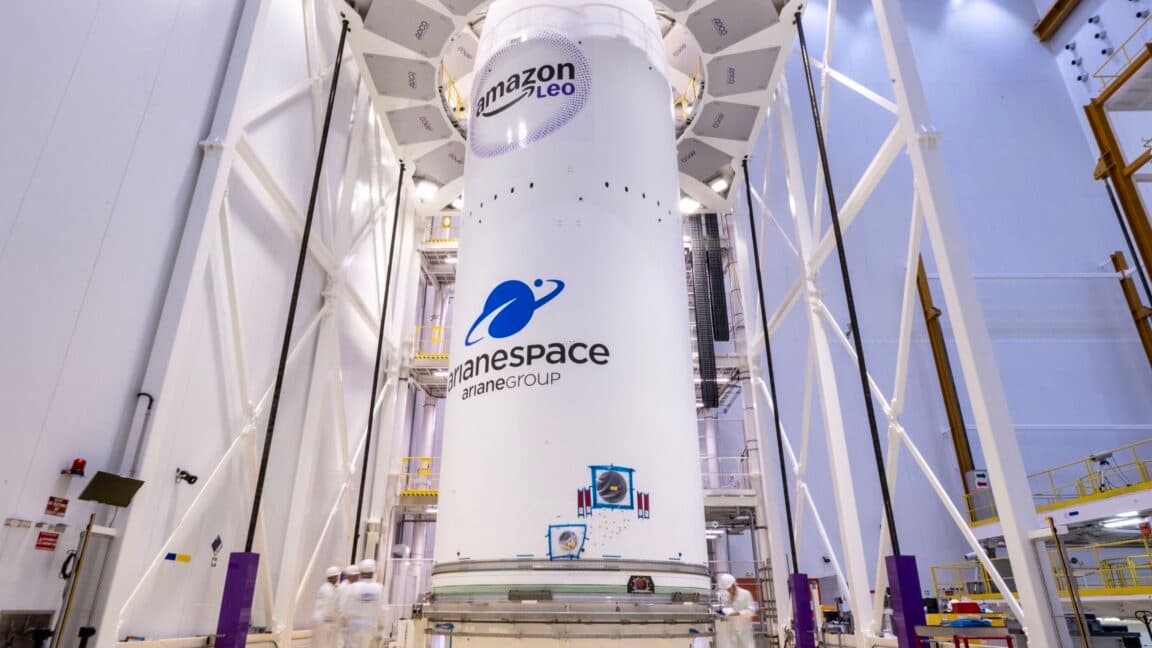
Against this backdrop, Europe's Ariane 64 rocket is emerging as one of the most dependable partners in Amazon's ambitious push to deploy a global broadband internet constellation. As Amazon waits on other large rockets that have yet to fully deliver on their promises, the European heavy-lift vehicle is doing the work — and doing it on schedule.
What Is Amazon's Project Kuiper?
Project Kuiper is Amazon's plan to build a constellation of thousands of satellites in low-Earth orbit (LEO) to provide high-speed, affordable broadband internet access to underserved communities around the world. The project is Amazon's answer to SpaceX's Starlink and represents a multi-billion-dollar investment in satellite internet infrastructure.
The constellation, when fully deployed, is expected to include more than 3,200 satellites. These satellites work by communicating with ground terminals to deliver internet connectivity to homes, businesses, and remote locations that traditional fiber or cable infrastructure can't easily reach. The stakes are enormous — not just commercially, but in terms of global connectivity and digital equity.
Hundreds of Satellites Are Ready, But Stuck on the Ground
During a teleconference with reporters, Metayer was candid about the current bottleneck facing the program. "They're built, and sitting in a payload processing facility waiting for trips to orbit," he said, describing a situation where manufacturing has outpaced the availability of launch vehicles capable of putting the satellites where they need to go.
This kind of logjam is not entirely surprising given the scale of the project, but it does highlight a critical dependency: Amazon's internet service ambitions are only as fast as the rockets available to carry its hardware into space. With production humming along at several satellites per day, every delay on the launch side directly impacts when Amazon can begin providing service to customers.
The Role of the Ariane 64 Rocket
In this context, the Ariane 64 has become one of Amazon's most important launch partners. The Ariane 64 is the four-booster variant of the Ariane 6 rocket developed by ArianeGroup and operated by Arianespace, launching from the Guiana Space Centre in Kourou, French Guiana. It is designed specifically for heavy-lift missions, making it well-suited to carrying large batches of satellites into orbit in a single flight.
Amazon's next mission — carrying approximately three dozen Kuiper satellites — is set to lift off aboard an Ariane 64, with liftoff targeted for 7:53 AM ET (11:53 UTC). The launch site in French Guiana offers a strategically advantageous equatorial location, which allows rockets to take better advantage of Earth's rotation and maximize payload capacity to orbit.
While some of the other large rockets Amazon had been counting on have faced delays, technical setbacks, or slower-than-expected ramp-up timelines, Ariane 64 has demonstrated a capacity to actually execute — delivering satellites to orbit and helping Amazon chip away at its growing ground inventory.
The Broader Launch Landscape for Amazon Kuiper
Amazon has secured launch contracts with multiple providers in an effort to diversify its launch portfolio and reduce dependence on any single rocket. The company has deals with United Launch Alliance (ULA) for its Vulcan Centaur rocket, with Blue Origin for the New Glenn rocket, and with Arianespace for the Ariane 6. Amazon also has a limited number of launches booked with SpaceX as a fallback option.
However, not all of these vehicles have progressed at the same pace. New Glenn and Vulcan Centaur have both faced development timelines that have stretched longer than originally anticipated, contributing to the current situation where Amazon's manufacturing pipeline is well ahead of its launch cadence. This imbalance underscores why the Ariane 64's reliability has become so valuable to the overall Project Kuiper deployment schedule.
Why Launch Cadence Matters for Amazon's Business Timeline
Amazon has regulatory commitments tied to its Project Kuiper deployment. The company is required to have a significant portion of its constellation in orbit by specific deadlines in order to retain its spectrum licenses from the Federal Communications Commission (FCC). Missing those milestones could have serious consequences for the entire project.
With that pressure in mind, every successful Ariane 64 launch represents not just a technical achievement, but a meaningful step toward protecting Amazon's commercial and regulatory position. Getting dozens of satellites into orbit per mission helps narrow the gap between what's been built and what's been deployed.
What Comes Next for Project Kuiper
Amazon has signaled that it intends to begin offering Project Kuiper internet service to customers in the near future, but the full rollout depends on reaching a minimum number of operational satellites in orbit. As the company continues manufacturing at pace, the focus now shifts squarely to launch frequency.
If Ariane 64 continues to perform reliably and other launch vehicles begin to reach their operational potential, Amazon could find itself closing the gap between production and deployment faster than critics have expected. For now, though, the company's path forward runs directly through the launchpads of Kourou — and the European rocket that has quietly become one of its most dependable partners in the race to connect the world from space.