
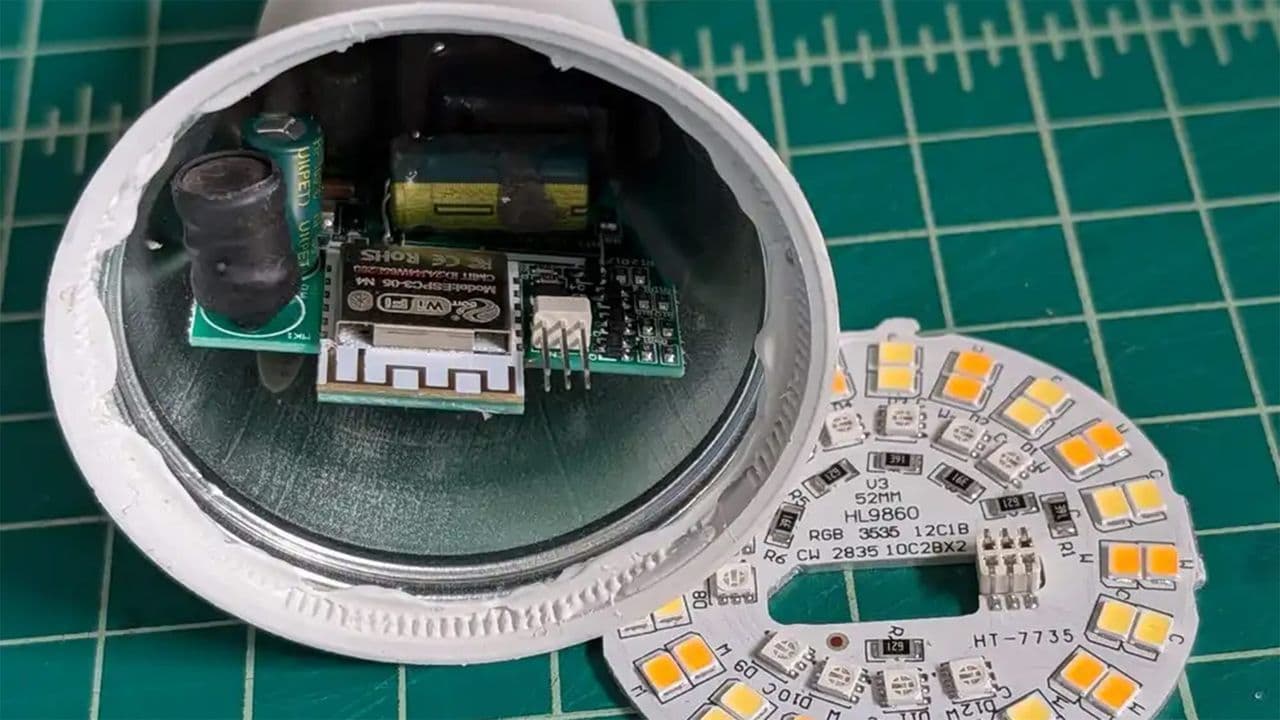
A Lightbulb Moment for Intellectual Freedom: The ESP32 Banned Book Library
What if the unassuming smart lightbulb screwed into your ceiling lamp was secretly serving thousands of pages of banned literature to anyone within Wi-Fi range? That is precisely the idea behind a remarkable open-source project in which a researcher hacked an ESP32-powered smart bulb into a fully functional Banned Book Library — no internet connection, no app, and no centralized authority required. It is a small piece of hardware making a very large statement about access to information in the digital age.
What Is the Banned Book Library Project?
At its core, the project repurposes a commercially available Wi-Fi smart lightbulb — the kind you might buy to control your home lighting with a smartphone — into a low-power web server that hosts digital books. The bulb broadcasts an open Wi-Fi access point that any nearby device can join freely. Once connected, users can navigate to a simple webpage and browse or download a curated collection of books that have been challenged, banned, or censored in various contexts around the world.
The entire project is open source, meaning that anyone with the right hardware and a modest amount of technical know-how can replicate, modify, and deploy their own version. The researcher published all necessary code and documentation, inviting the global maker community to participate in what is essentially a distributed, censorship-resistant lending library that fits in the palm of your hand — and doubles as functional home lighting.
The Hardware: Why the ESP32?
The ESP32 is a powerful, low-cost microcontroller developed by Espressif Systems. It has become a favorite in the maker and hobbyist community because it packs dual-core processing, integrated Wi-Fi and Bluetooth capabilities, and generous memory into a tiny, inexpensive chip. Many modern smart home devices — including certain smart lightbulbs — are built around the ESP32 or its predecessor, the ESP8266.
For this project, the ESP32's built-in Wi-Fi stack is the key ingredient. The chip is capable of operating in Access Point (AP) mode, meaning it can broadcast its own wireless network entirely independently of any existing router or internet infrastructure. This is what allows the bulb to serve content to nearby devices even in locations with no internet access whatsoever — a library in a blackout zone, a community center in a rural area, or simply a bookshelf in someone's living room.
The ESP32's flash storage is used to hold the actual book files, typically stored as plain text, EPUB, or lightweight HTML documents to keep file sizes manageable within the chip's available memory. A simple web server running on the microcontroller handles incoming HTTP requests, presenting users with a clean, browsable interface when they visit the device's local IP address after connecting to its Wi-Fi network.
How the System Works Step by Step
The workflow is elegantly straightforward. The modified smart bulb powers on and immediately begins broadcasting an open Wi-Fi network — no password required. A user nearby sees this network on their phone, tablet, or laptop and connects to it just as they would any public hotspot. Their device is then assigned a local IP address by the ESP32, and a captive portal or simple redirect leads them to the library's homepage.
From there, the experience resembles browsing any lightweight digital library. Users can scroll through available titles, read books directly in their browser, or download files for offline use. The entire interaction happens locally, over the chip's own network, meaning there is no tracking, no data collection, and no external server logging who read what. The privacy implications alone make this project noteworthy.
The Cultural and Political Significance
Book banning is not a relic of history. In recent years, challenges to books in school districts, public libraries, and educational institutions have surged across multiple countries. Titles addressing race, gender identity, sexuality, and political dissent have been removed from shelves in communities that cite moral, religious, or political objections. For many readers — especially young people — losing access to these works can mean losing access to perspectives that speak directly to their own lived experiences.
The Banned Book Library project is a direct, hardware-level response to that trend. By embedding a library inside an object as mundane and overlooked as a lightbulb, the researcher highlights both the ingenuity available to those who value open access to information and the absurdity of attempting to suppress ideas in a world full of programmable microcontrollers. The project draws a straight line from the samizdat tradition — the underground circulation of censored texts in Soviet-era Eastern Europe — to the open-source hardware movement of the twenty-first century.
Open Source Means Anyone Can Build One
Perhaps the most powerful aspect of the project is its replicability. Because the code and hardware specifications are freely available, the Banned Book Library is not a single artifact — it is a blueprint. A teacher in a country with restricted internet access could deploy one. A librarian facing political pressure to remove titles could quietly install one on a reading room shelf. A student who wants to share classic works of literature with classmates could build one for less than the cost of a single paperback.
- The ESP32 development boards needed for the project cost well under ten dollars in most markets.
- Compatible smart bulb housings are widely available and require only basic soldering skills to modify.
- The software stack is built on well-documented, beginner-friendly frameworks commonly used in the Arduino and ESP-IDF ecosystems.
- Book files sourced from Project Gutenberg and similar archives are in the public domain and freely redistributable.
Privacy, Legality, and Ethical Considerations
The project naturally raises questions about legality, particularly regarding copyright. The researcher's implementation focuses on books that are either in the public domain or formally included on recognized banned books lists — many of which are available through legitimate open-access repositories. However, anyone building their own version would need to carefully consider the copyright status of any titles they include in their personal deployment.
On the privacy front, the offline, local-only nature of the system is a genuine strength. Unlike cloud-based e-book platforms, the ESP32 library keeps no logs, shares no data, and requires no account creation. Reading a book on this system is closer to borrowing a physical copy from a neighbor than to checking out a digital title from a service that monitors your reading habits.
The Bigger Picture: Resilient Information Infrastructure
The Banned Book Library project is part of a growing movement to build resilient, decentralized information infrastructure using affordable consumer hardware. Projects like PirateBox, LibraryBox, and various mesh networking initiatives have long explored how to distribute information without relying on centralized servers or corporate platforms. The ESP32 bulb library carries that tradition into an even more miniaturized and inconspicuous form factor.
In a world where digital content can be removed from platforms with a single policy decision, where app stores can delist reading applications overnight, and where entire domains can be blocked at the network level, a library that lives inside a lightbulb and runs without any external infrastructure is more than a clever hack. It is a reminder that the tools of information freedom are increasingly available to anyone with curiosity, a soldering iron, and an afternoon to spare.
Whether you see it as a protest, a proof of concept, or simply an impressive piece of maker engineering, the ESP32 Banned Book Library is the kind of project that makes you look at the ordinary objects around you just a little differently — and wonder what else might be hiding inside them.