
ASML Pushes Back Hard Against US Government EUV Shipment Claims
Dutch semiconductor equipment giant ASML has issued a firm denial in response to a US government report alleging that one of its cutting-edge Extreme Ultraviolet (EUV) lithography machines had been shipped to China. The company called the claims "inaccurate and damaging to our reputation," marking a rare and pointed public rebuke of an official government narrative. The incident has sent ripples through the global semiconductor industry, reigniting debate over export controls, geopolitical tensions in chip manufacturing, and the credibility of intelligence reporting on technology trade.
What the US Government Report Alleged
According to reports circulating from US government sources, at least one ASML EUV system — the most advanced lithography tool available in the world today — had allegedly made its way into China, in potential violation of strict export control regulations. EUV machines are considered so strategically sensitive that the Dutch government, under pressure from Washington, has refused to issue export licenses for their sale to Chinese customers since 2019. The US government has long viewed EUV technology as a critical national security asset, capable of enabling China to manufacture advanced semiconductors that could power next-generation military and artificial intelligence systems.
The report, if true, would represent one of the most significant breaches of Western semiconductor export policy in recent memory. It would also raise serious questions about enforcement mechanisms and supply chain oversight within the global chip equipment industry.
ASML's Response: A Direct and Unequivocal Denial
ASML moved quickly to counter the narrative. In an official statement, the company described the reports as "rumors" and stated emphatically that they are "inaccurate and damaging to our reputation." The Veldhoven-based company, which holds a near-total monopoly on EUV lithography technology, stressed that it operates in full compliance with all applicable export control laws and licensing requirements in every market it serves.
ASML also noted that its shipments are subject to extensive regulatory scrutiny, and that no EUV system has been delivered to any customer in China. The company has long been forbidden from exporting its most advanced EUV tools to Chinese chipmakers such as SMIC, following Dutch government decisions made in coordination with US trade policy. ASML does sell older, less advanced Deep Ultraviolet (DUV) lithography systems to Chinese clients, but even those sales have faced increasing restrictions in recent years.
Why EUV Technology Is So Strategically Important
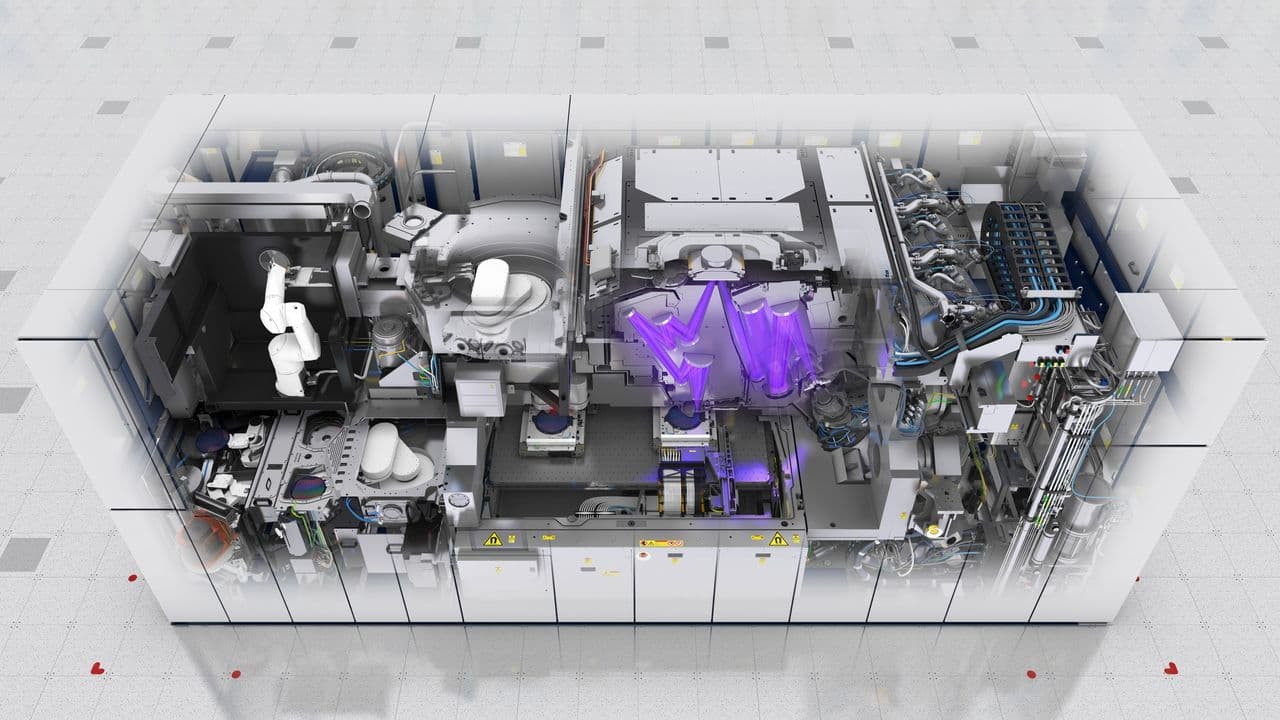
To understand the gravity of the allegations — and ASML's forceful response — it helps to appreciate just how central EUV lithography is to the future of semiconductor manufacturing. EUV machines use extremely short wavelengths of light to etch transistors onto silicon wafers at resolutions previously thought impossible. This technology is the backbone of chips built at 7nm, 5nm, 3nm, and even smaller nodes — the kinds of chips found in smartphones, data centers, AI accelerators, and advanced defense systems.
ASML is the only company in the world capable of producing EUV machines at scale, making each unit a geopolitically significant piece of hardware. A single high-NA EUV system can cost upwards of $350 million. Governments in the United States, Europe, Japan, and elsewhere have treated access to these machines as a lever of economic and military power, restricting their export as part of a broader strategy to limit China's ability to develop a competitive domestic semiconductor industry.
The Broader Context: US-China Chip Wars
The allegations and ASML's denial did not emerge in a vacuum. They come amid an intensifying global competition over semiconductor supply chains, with the United States and its allies working to contain China's technological rise through a coordinated series of export controls. The Biden administration's sweeping October 2022 chip export rules, later reinforced and expanded, targeted advanced chips, chip-making equipment, and the engineers who support them. The Netherlands followed suit by tightening DUV export licensing in 2023.
China, for its part, has invested hundreds of billions of dollars in domestic chip development through initiatives like the China Integrated Circuit Industry Investment Fund, commonly known as the "Big Fund." Despite these investments, Chinese chipmakers have struggled to close the gap with TSMC, Samsung, and Intel without access to EUV tools. That is precisely why even a rumor of an ASML EUV machine reaching Chinese shores carries such explosive implications.
Reputational Stakes for ASML
For ASML, the stakes of being associated with an export violation — even through inaccurate reporting — are extremely high. The company's ability to operate globally depends on maintaining regulatory trust with governments in the Netherlands, the United States, and across the EU. Any suggestion that ASML had circumvented export controls, whether through negligence or deliberate action, could trigger investigations, license suspensions, or sanctions that would threaten its core business.
ASML has built its reputation over decades as a reliable, law-abiding partner to the world's most advanced chipmakers. Its customers include TSMC, Samsung, Intel, and SK Hynix — companies that themselves operate under intense regulatory scrutiny. A compliance failure at ASML would have cascading consequences across the entire semiconductor ecosystem.
What Happens Next
ASML's denial is unlikely to fully extinguish the controversy. US lawmakers and national security officials have shown a willingness to investigate such claims aggressively, and the original source of the government report has not publicly retracted its findings. Independent verification of what actually occurred — or did not occur — may take time, given the classified nature of much trade intelligence.
- Dutch regulators and export licensing authorities may face calls to conduct an independent review of ASML's recent shipment records.
- US congressional committees focused on national security and technology may request briefings or initiate oversight hearings on the matter.
- ASML's stock and customer relationships could face short-term pressure until the matter is fully resolved and clarified.
- The episode may accelerate calls for even more stringent international tracking mechanisms for high-value semiconductor equipment.
A Defining Moment for Semiconductor Export Policy
Regardless of how the specific allegations are ultimately adjudicated, this episode underscores a fundamental tension in the global semiconductor industry: the technology is too important, and too dual-use in nature, for governments to leave its flow to market forces alone. ASML finds itself at the center of that tension — not by choice, but by virtue of its unique position as the world's most critical chipmaking equipment supplier.
The company's swift and unequivocal denial reflects not just a defense of its legal standing, but a recognition that its long-term credibility with regulators, customers, and investors depends on being seen as an actor of the highest integrity. As geopolitical pressures on the semiconductor industry continue to mount, ASML's every move will remain under intense global scrutiny — and every rumor, accurate or not, carries the potential to reshape the conversation around who controls the future of chip manufacturing.