
Google's AMIE Medical AI Rivals Primary Care Physicians in New Nature Study
Artificial intelligence has steadily made its way into nearly every corner of modern life, but few applications carry higher stakes than healthcare. A landmark new study published in the prestigious journal Nature has revealed that AMIE — Google's conversational AI system designed for medical use — is capable of performing at a level comparable to primary care physicians when it comes to managing complex health conditions. The findings represent one of the most significant milestones yet in the development of AI-assisted medicine, and they raise compelling questions about how technology could reshape the future of healthcare delivery.
What Is AMIE and Why Does It Matter?
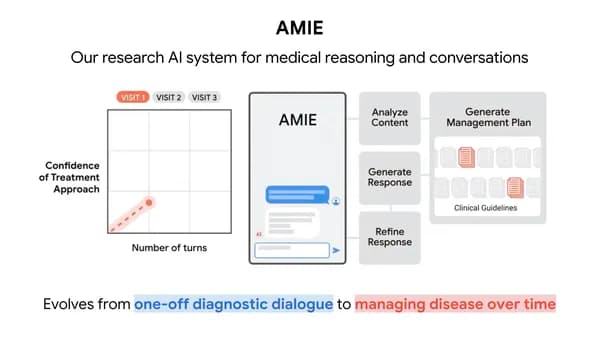
AMIE, which stands for Articulate Medical Intelligence Explorer, is a conversational AI system developed by Google Research. Unlike general-purpose AI chatbots, AMIE was specifically designed and trained to engage in clinically meaningful dialogue. It can ask nuanced follow-up questions, synthesize patient-reported symptoms, and reason through diagnostic and management pathways much the way a trained physician would during a consultation.
The significance of this system cannot be overstated. Primary care physicians are the backbone of healthcare systems worldwide, and yet many countries face serious shortages of these professionals. Long wait times, overburdened clinics, and limited access to specialists in rural or underserved communities mean that millions of people go without timely, high-quality medical guidance. A well-validated AI system capable of thoughtful disease management could help bridge that gap in a meaningful and life-changing way.
What the Nature Research Actually Found
The study published in Nature evaluated AMIE's performance across a series of complex, multi-condition disease management scenarios. Researchers compared the AI's outputs with those of licensed primary care physicians, assessing factors such as diagnostic accuracy, the quality of management plans, and the clarity and empathy of communication.
The results were striking. AMIE matched primary care physicians across several key performance metrics, demonstrating that a well-designed conversational AI system can navigate clinical complexity at a level previously thought to require years of medical training and human judgment. Importantly, this was not a narrow or overly simplified test. The cases involved chronic disease management, comorbidities, and the kind of nuanced clinical reasoning that separates competent care from truly excellent care.
How AMIE Approaches Complex Disease Management
One of the most impressive aspects of AMIE is how it conducts a medical conversation. Rather than simply returning a list of possible diagnoses based on a set of typed symptoms, the system engages in a dynamic, iterative dialogue. It asks clarifying questions, adapts its reasoning based on new information, and provides explanations that patients can actually understand.
This approach mirrors what good clinicians do naturally. A skilled primary care doctor does not simply run through a checklist — they listen, probe, synthesize, and then explain. AMIE has been trained to replicate this process, which is a substantial leap beyond what earlier generation health chatbots were capable of delivering.
Areas where AMIE demonstrated particular strength include:
- Managing patients with multiple chronic conditions simultaneously, such as diabetes alongside cardiovascular disease
- Structuring follow-up recommendations and monitoring plans tailored to individual patient profiles
- Communicating risk clearly without causing unnecessary alarm or confusion
- Adapting explanations to the apparent health literacy level of the person it is speaking with
The Broader Implications for Healthcare AI
Research of this caliber published in Nature carries enormous weight in both the scientific and medical communities. It signals that we are entering a new phase in the maturity of healthcare AI — one where systems are no longer simply tools for information retrieval, but active participants in clinical reasoning and patient communication.
This does not mean AI is poised to replace physicians. The researchers and Google's team have been careful to frame AMIE as a system that could complement and extend human medical care, not substitute for the irreplaceable human elements of diagnosis, physical examination, and the therapeutic relationship between doctor and patient. Rather, the vision is one of augmentation — using AI to extend the reach of skilled clinical thinking to more people, more consistently, and at greater scale.
For patients in underserved areas, for people managing multiple chronic illnesses who struggle to get timely specialist input, and for healthcare systems straining under demand, this kind of AI capability could prove transformative. Early access to structured, intelligent medical guidance can prevent conditions from worsening, reduce emergency visits, and support better long-term health outcomes.
What Comes Next for AMIE and Medical AI Research
While the Nature study is a major step forward, researchers acknowledge that significant work remains before systems like AMIE can be deployed safely and responsibly in real clinical environments. Validation across diverse patient populations, regulatory oversight, integration with electronic health records, and robust mechanisms for human oversight are all essential pieces of the puzzle that must be assembled carefully.
Google has signaled its commitment to rigorous, safety-first development of medical AI, and the publication of this research in a peer-reviewed journal is itself a reflection of that commitment to scientific transparency and accountability.
A Turning Point in the Story of Healthcare AI
The AMIE research published in Nature is more than a headline — it is a landmark data point in a longer story about how AI is learning to think, communicate, and reason in domains that were once exclusively human. As research continues and safety standards evolve, systems like AMIE may come to play a routine and genuinely valuable role in helping people manage their health with greater confidence, access, and clarity than ever before. The potential is immense, and the responsibility to realize it carefully is equally great.