
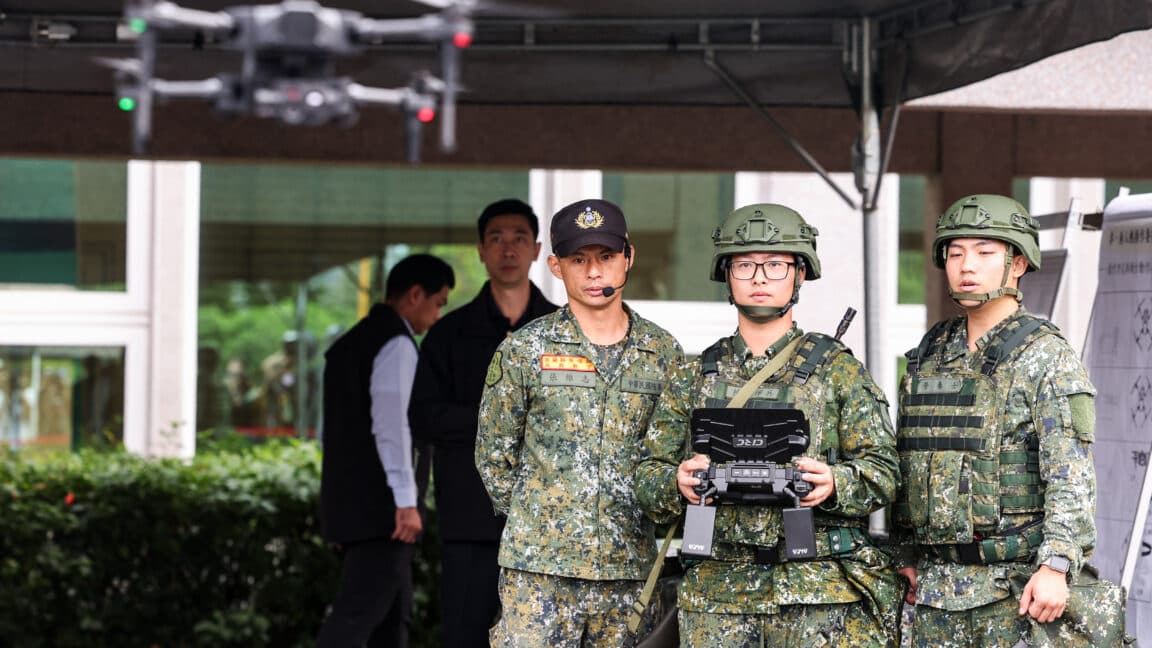
Taiwan's Drone Strategy: Building a Deterrent Against China
In one of the most strategically significant military build-ups in the Indo-Pacific region, Taiwan is sharply accelerating its domestic drone production program. Faced with persistent and growing pressure from China, the self-governing democratic island is betting heavily on unmanned aerial systems — both to defend its own shores and to forge deeper military ties with the United States. The moves reflect a broader global trend toward drone-centric warfare, but for Taiwan, the stakes are uniquely existential.
A $6.6 Billion Bet on Unmanned Systems
Taiwan's Ministry of National Defense has proposed a sweeping special budget that would allocate approximately $6.6 billion over six years — from 2026 to 2031 — specifically for the procurement of domestically manufactured military drones. The proposal, presented on June 18 and reported by Taiwan's Central News Agency, outlines an ambitious acquisition plan designed to transform the island's defensive posture from the ground up.
Under the plan, Taiwan would purchase more than 208,000 coastal attack drones, over 1,400 coastal reconnaissance drones, and approximately 1,320 uncrewed surface vessels. These numbers are not merely impressive on paper — they represent a fundamental shift in how Taiwan intends to resist any potential military incursion from the Chinese mainland.
For context, Taiwan's current drone arsenal stands at roughly 5,000 drones, including both US-made attack systems and domestically produced platforms, according to Resilience Media. The proposed budget would increase that number by more than fortyfold, flooding Taiwan's coastal defense network with low-cost, high-volume unmanned systems that could significantly complicate any amphibious or aerial assault.
Why Drones Are Central to Taiwan's Defense Doctrine
Military analysts have long argued that Taiwan's best chance of resisting a Chinese invasion lies not in matching Beijing's vast conventional military forces weapon-for-weapon, but in deploying asymmetric capabilities that raise the cost of any attack to an unacceptable level. Drones fit perfectly into this doctrine.
Coastal attack drones can be deployed in massive swarms to target landing craft, warships, and amphibious vehicles. Reconnaissance drones provide real-time intelligence over the Taiwan Strait, one of the world's most closely watched bodies of water. Uncrewed surface vessels add a maritime dimension to Taiwan's layered defense, capable of patrolling shallow coastal areas where larger naval assets cannot easily operate.
The Ukraine conflict has provided a powerful real-world demonstration of how a smaller, outgunned military can use drones to inflict serious losses on a far larger invading force. Taiwan's defense planners have been paying close attention, and the $6.6 billion proposal is, in many ways, a direct application of those battlefield lessons to the Taiwan Strait scenario.
Live-Fire Exercises Showcase New Capabilities
Taiwan is not simply planning for the future — it is already training its forces with advanced drone systems. During military exercises held in early June, Taiwanese soldiers fired Altius-600 loitering munition drones from towed flatbed launchers, successfully striking offshore targets. The Altius-600 is manufactured by a subsidiary of Anduril Industries, a prominent US defense technology company, underscoring how deeply American technology is already embedded in Taiwan's evolving drone warfare program.
Loitering munitions — sometimes called "kamikaze drones" — are a particularly effective category of unmanned system because they can orbit a target area for extended periods before striking with precision. Their relatively low cost compared to conventional missiles makes them ideal for large-scale coastal defense scenarios, where volume and persistence matter as much as individual lethality.
In a separate exercise conducted earlier in 2025, Taiwanese Marines used Taiwan-made drones to strike maritime targets, demonstrating that domestic production is already yielding combat-capable systems. These exercises send a clear signal: Taiwan's drone program has moved well beyond the prototype stage.
International Partnerships and the US Military Connection
Beyond purely defensive goals, Taiwanese drone companies are actively pursuing international commercial and military partnerships. Several firms are in discussions — and in some cases already under contract — to supply drones and drone components to the US military and other overseas buyers. This represents a significant evolution in Taiwan's role in the global defense supply chain.
The United States has strong incentives to encourage these partnerships. Washington is eager to diversify its drone supply chains away from dependence on any single source, and Taiwanese manufacturers offer a combination of technological sophistication and geopolitical alignment that makes them attractive suppliers. For Taiwan, selling to the US military creates revenue that funds further domestic research and development, while also deepening the strategic relationship with its most important security partner.
Taiwanese citizens are also being drawn into the drone ecosystem at the grassroots level, with growing numbers signing up for drone flight training programs. This civilian engagement builds a deeper pool of qualified operators who can support military missions if needed — a lesson drawn directly from Ukraine, where civilian drone pilots have played an active and often decisive role on the battlefield.
The Bigger Picture: Taiwan's Place in a Changing Security Landscape
Taiwan's drone expansion does not exist in a vacuum. It is part of a broader regional arms buildup driven by China's continued military modernization, increasingly assertive posture in the Taiwan Strait, and repeated incursions into Taiwan's air defense identification zone. The United States, Japan, South Korea, the Philippines, and Australia are all recalibrating their defense strategies in response to the same pressures.
For Taiwan specifically, the message embedded in the $6.6 billion drone proposal is unmistakable: the island intends to make any military attack prohibitively costly. With hundreds of thousands of autonomous systems patrolling its coastlines, Taiwan is building a drone-based deterrent designed to hold the line — and to make the world's most watched potential conflict as unlikely to begin as possible.
Key Takeaways
- Taiwan's Ministry of National Defense has proposed a $6.6 billion, six-year special budget for domestic drone procurement covering 2026 to 2031.
- The plan includes over 208,000 coastal attack drones, 1,400-plus reconnaissance drones, and more than 1,320 uncrewed surface vessels.
- Taiwan's current drone inventory stands at approximately 5,000 units — the proposed expansion would increase this by more than fortyfold.
- Recent exercises showcased the Altius-600 loitering munition from Anduril Industries alongside Taiwan-made maritime strike drones.
- Taiwanese drone companies are forming international partnerships to supply the US military and other overseas buyers, deepening strategic ties with Washington.
- Civilian drone training programs are expanding across Taiwan, broadening the pool of qualified operators available for national defense.