
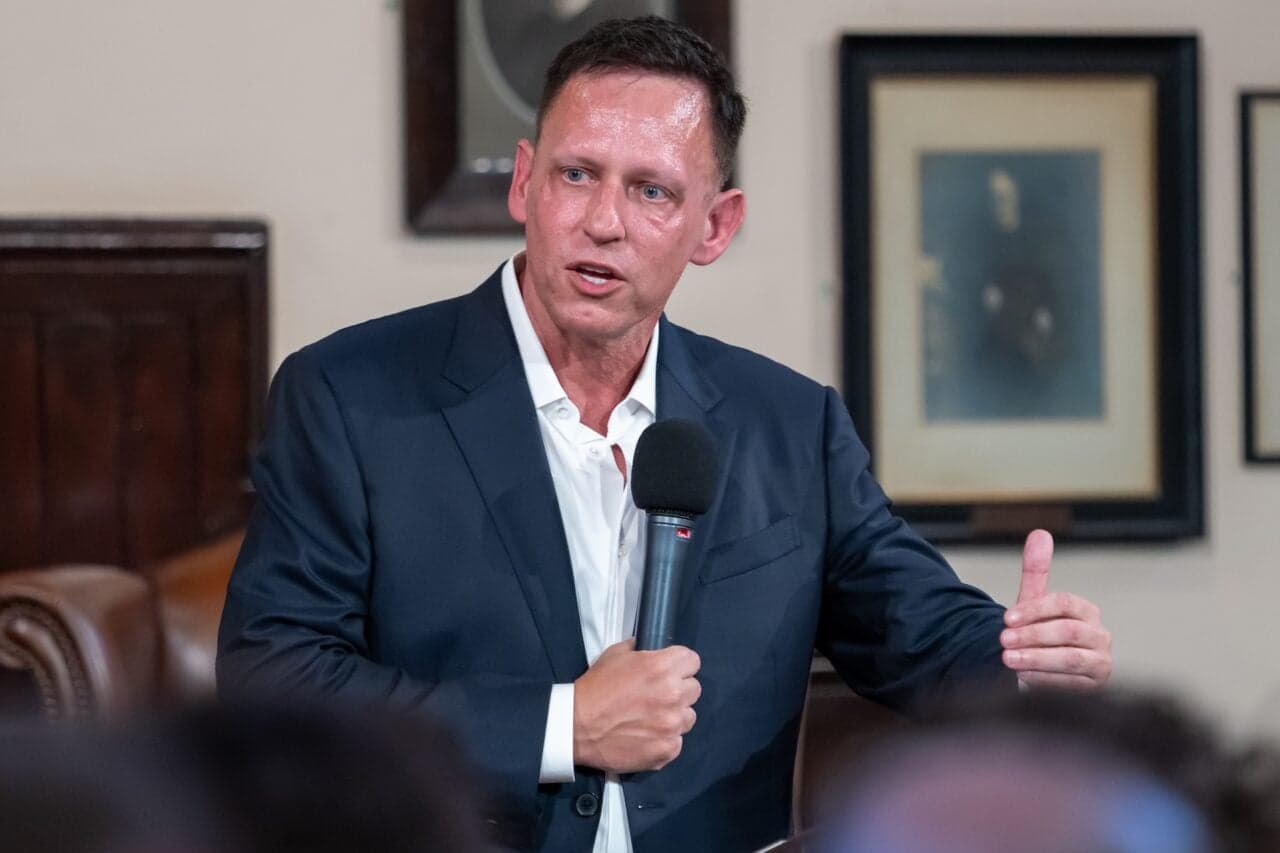
What Happens When a Billionaire Can't Find the Illuminati?
There's a recurring fantasy that somewhere, in a wood-paneled room lit by candlelight, the world's most powerful people gather to decide the fate of civilization. They have secret handshakes, matching robes, and a coordinated agenda that explains every geopolitical twist and financial upheaval you've ever struggled to make sense of. The Illuminati, in other words. The problem — at least for the type of person who would genuinely want to join such a group — is that it doesn't exist. And if you're Peter Thiel, that's less a relief and more a logistical inconvenience.
The PayPal co-founder, early Facebook investor, Palantir architect, and self-styled philosopher-king of Silicon Valley has spent decades doing something that sounds almost satirical when you say it out loud: building, from scratch, the closest real-world equivalent to the shadowy elite network that conspiracy theorists have always warned us about. And recently, that effort apparently involved getting Joseph Gordon-Levitt on the phone. Yes, that Joseph Gordon-Levitt.
Peter Thiel and the Architecture of Influence
To understand what Thiel is doing, you have to understand how he thinks. He is, above almost everything else, a man who believes that most people are not paying close enough attention. His book Zero to One, his Thiel Fellowship, his political donations, and his investment philosophy all share a common thread: a conviction that the conventional path is a trap, and that the people willing to think differently — and act on it — are the ones who actually shape history.
That worldview has practical consequences. If you believe that the world is run not by institutions or democratic processes but by small groups of highly networked individuals making decisive bets, then the rational response isn't to complain about it. It's to become one of those people, and to build your own group. Which is precisely what Thiel has spent the better part of three decades doing.
The PayPal Mafia, as it came to be known, was arguably the first proof of concept. That loose confederation of founders, engineers, and investors — Elon Musk, Reid Hoffman, Max Levchin, and others — dispersed after PayPal's acquisition by eBay in 2002 and went on to seed much of what became modern Silicon Valley. It wasn't a secret society. It was something arguably more powerful: a genuine network of trust, shared experience, and mutual interest, operating largely outside public view.
When Conspiracy Theory Meets Venture Capital
The Illuminati mythos endures because it offers a satisfying explanation for a genuinely uncomfortable truth: concentrated power is real, and it does operate through relationships that most people never see. What the conspiracy theory gets wrong is the centralization — the idea of one group, one agenda, one master plan. What it gets right is the basic social mechanics: that access to the right people, at the right time, changes what's possible.
Thiel has long understood this, and his approach to network-building reflects it. His investments are rarely purely financial. They are relational. When he funds a company or a political candidate or a legal battle — most famously his secret financing of Hulk Hogan's lawsuit against Gawker — he is also purchasing proximity, loyalty, and leverage. He is, quite deliberately, doing what the Illuminati was always supposed to do, except transparently enough that it's hiding in plain sight.
Joseph Gordon-Levitt and the Culture of Access
The detail about Joseph Gordon-Levitt is striking precisely because it seems so out of place — and yet it makes a strange kind of sense. Thiel has never confined his network-building to Silicon Valley or Washington. He is deeply interested in culture, in the way ideas propagate, in who shapes the stories that shape the world. Actors, writers, filmmakers, and intellectuals have always had a role in the informal power structures that actually move public opinion, and Thiel is too strategic a thinker to ignore that.
What the Gordon-Levitt connection illustrates is the breadth of Thiel's ambition. This isn't a network confined to engineers and venture capitalists. It sprawls across industries, ideologies, and disciplines — connecting people who might otherwise never meet, under the implicit umbrella of Thiel's own worldview and interests.
The Real Illuminati Problem
Here's the irony at the heart of all this: the reason the Illuminati doesn't exist is not that powerful people don't try to coordinate. It's that sustained, centralized, secret coordination at scale is extraordinarily difficult. People defect. Agendas diverge. Egos collide. What Thiel has built works not because it's a secret society with rigid membership and unified goals, but because it's a decentralized web of relationships held together by shared assumptions, mutual benefit, and the gravitational pull of one man's reputation and resources.
That's messier than the Illuminati myth. It's also significantly more durable.
Why This Matters Beyond the Conspiracy Theory Framing
It would be easy to dismiss all of this as the overwrought projection of people who spend too much time on Reddit. But the serious version of the question deserves a serious answer. When private networks of wealthy, ideologically aligned individuals can fund lawsuits, shape political outcomes, seed dominant technology companies, and cultivate cultural influence — all without formal accountability — the public interest case for paying attention becomes hard to ignore.
- Thiel's Palantir has deep ties to U.S. intelligence and law enforcement agencies.
- His political spending helped reshape the Republican Party's relationship to Silicon Valley.
- The Thiel Fellowship actively recruits young people away from traditional institutional paths and into his orbit.
- His venture investments have shaped which technologies receive resources and which do not.
None of this is secret. None of it requires a conspiracy theory to explain. And that, in the end, is the most important point: the real version of elite network power is not hidden in the shadows. It's operating in the open, counting on the fact that most people find the mechanics of influence too boring to follow closely. Peter Thiel doesn't need to join the Illuminati. He just needs people to keep assuming it's fiction.