
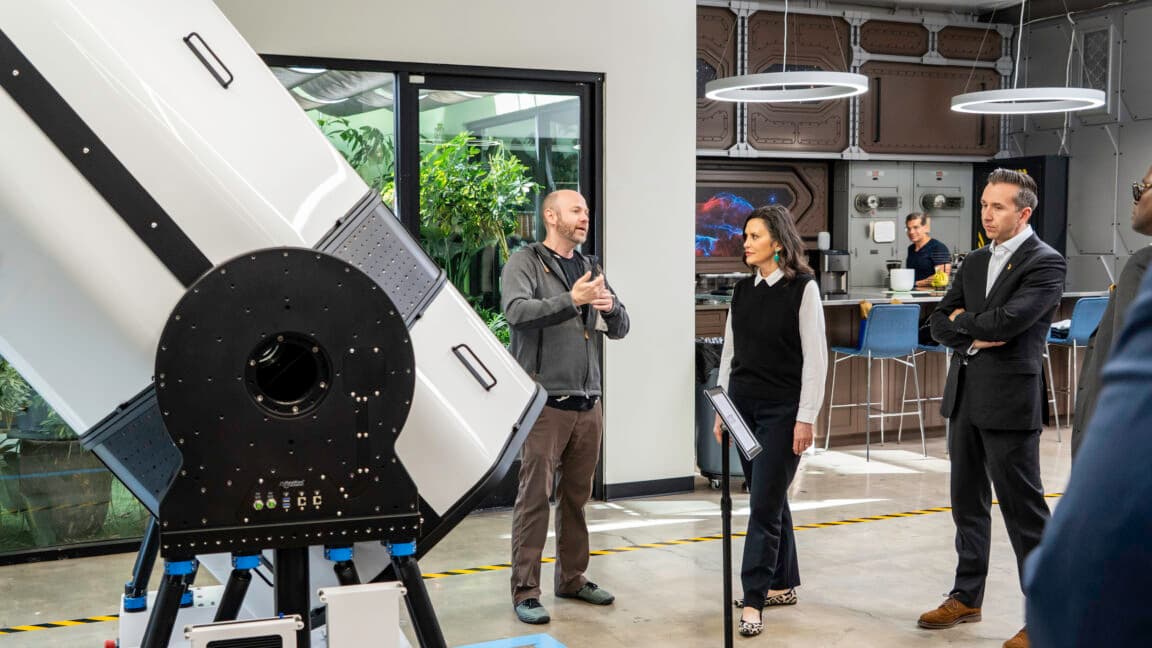
From Hacking Code to Harnessing Light: The Remarkable Journey of Dan Roelker
In the rolling foothills of the Blue Ridge Mountains, overlooking the sweeping green expanse of Virginia's Shenandoah Valley, a former hacker named Dan Roelker is thinking about something far bigger than computer networks. He's thinking about light — specifically, about who controls it, who collects it, and why that race may define the future of technology, energy, and even civilization itself.
Standing at an overlook near Bluemont, Virginia, whiskey in hand from the local Catoctin Creek distillery, Roelker delivered a line that sounds like it belongs in a science fiction novel but is rooted in a very real technological ambition: "If you can control light, you can control space. So it's basically a race for who is collecting the most light."
It's a bold claim. But coming from a man who once operated in the shadowy world of hacking before pivoting to the frontier of light-based technology, it's one worth taking seriously.
Who Is Dan Roelker? A Hacker Who Found a Higher Calling
Dan Roelker's backstory reads like a tech thriller. Once embedded in the world of hacking — where the goal is to find, exploit, and manipulate systems — Roelker eventually underwent a profound transformation. Rather than breaking into systems, he turned his attention to building something. Rather than operating in the dark, he became obsessed with light.
This kind of pivot is not unheard of in the technology world. Many of the most creative minds in the industry have backgrounds that blur the lines between disruption and innovation. What makes Roelker's story particularly compelling is not just that he changed direction, but the direction he chose: the harvesting and control of light as a foundational technology for the future.
His passion is evident. On a pleasant spring afternoon in the Virginia countryside, surrounded by natural beauty and the warm glow of a setting sun, Roelker spoke with the enthusiasm of someone who sees not just the present world, but the one coming next — a world shaped by whoever wins the race to collect and control light at scale.
Why Light? Understanding the Science and Strategy Behind Light Collection
To understand why Roelker is so fixated on light, it helps to think about what light actually represents in technological terms. Light is energy. It is information. It is the medium through which we communicate across fiber-optic cables, power our solar panels, and increasingly, process data in emerging photonic computing systems.
The technologies that depend on light are expanding rapidly. Solar energy harvesting continues to grow as one of the most critical tools in the fight against climate change. Photonic chips — which use light instead of electrons to process information — are increasingly seen as the next frontier in computing, offering speed and efficiency that traditional silicon chips cannot match. LiDAR systems, which use laser light to map environments, are powering self-driving vehicles and advanced robotics. Optical communications form the backbone of the modern internet.
In each of these domains, the central challenge is the same: how do you collect, direct, and use light as efficiently and effectively as possible? Roelker's assertion that controlling light means controlling space isn't metaphorical — it's a technical and strategic reality playing out across multiple industries simultaneously.
The Race to Collect the Most Light: Who Are the Players?
When Roelker talks about a race to collect light, he's describing a global competition involving some of the most powerful companies and governments on Earth. Here's a look at the key arenas where that race is already underway:
- Solar Energy: Nations and corporations are investing hundreds of billions of dollars in solar infrastructure. The ability to capture sunlight efficiently and convert it to usable energy is one of the defining technological challenges of this century. Advances in photovoltaic materials, concentrating solar power, and space-based solar collection are all part of this race.
- Photonic Computing: Tech giants and startups alike are pouring resources into chips that process data using photons instead of electrons. These systems promise to be orders of magnitude faster and more energy-efficient, fundamentally changing what computers can do.
- Optical Communications: From undersea fiber-optic cables to free-space optical communication between satellites, controlling light-based data transmission is a strategic priority for every major technology power.
- Defense and Surveillance: Light-based sensing systems, including LiDAR, infrared imaging, and directed-energy weapons, are reshaping modern defense technology. Whoever controls the most sophisticated light collection and projection systems holds a significant strategic advantage.
What a Hacker's Mindset Brings to the Challenge
One of the more intriguing dimensions of Roelker's story is how his background in hacking may actually be an asset in the world of light technology. Hackers are, at their core, systems thinkers. They look for weaknesses, inefficiencies, and unconventional pathways through complex architectures. Applied to light collection technology, that mindset could be exactly what's needed to find breakthroughs that more conventional researchers might overlook.
The history of technology is full of examples where outsiders — people who didn't grow up inside an industry's established assumptions — came in and found solutions that insiders couldn't see. Roelker's trajectory from hacker to light-tech visionary fits that pattern perfectly.
Light as the New Frontier
Standing in the Shenandoah Valley as the sun moved lazily across the sky, Dan Roelker's vision felt both grounded and expansive. The landscape around him — lit by the same star that has powered life on Earth for billions of years — served as a reminder of just how much energy is already out there, waiting to be collected.
The question, as Roelker sees it, is simple: who is going to collect it? In a world increasingly defined by energy scarcity, data speed, and technological supremacy, light may well be the most valuable resource of the coming century. And if that's true, then the race Roelker describes is not just a technological competition — it's a defining contest for the future itself.
For a former hacker who once specialized in seeing systems others couldn't, that might be exactly the kind of challenge worth dedicating a life to.