
Canvas Data Breach Sends Shockwaves Through Schools and Universities Across the United States
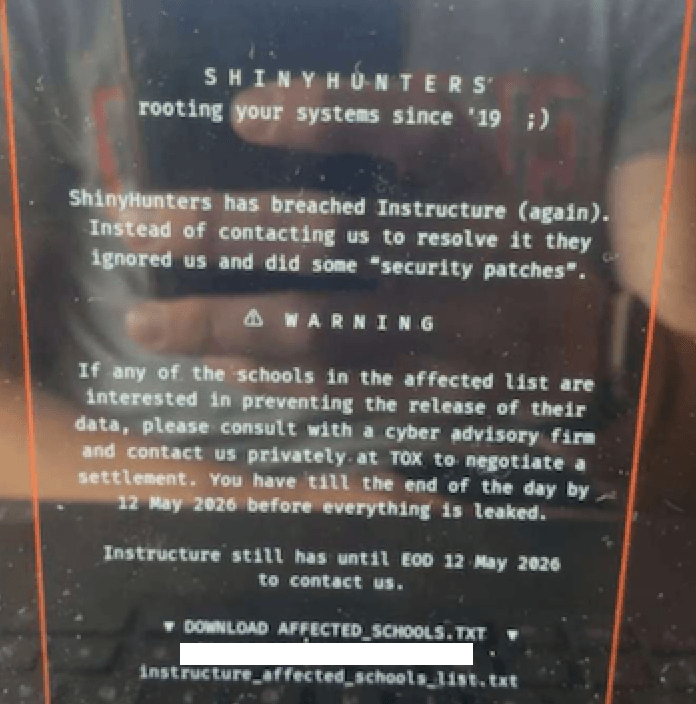
A sweeping cybersecurity incident targeting Canvas, one of the most widely used learning management systems in the country, has thrown thousands of educational institutions into chaos. The attack, carried out by the notorious cybercrime group ShinyHunters, involved the defacement of Canvas's login page with a ransom demand threatening to expose the personal data of approximately 275 million students and faculty members at nearly 9,000 institutions. The disruption forced Canvas's parent company, Instructure, to take the platform entirely offline, interrupting classes, coursework, and communications at school districts and universities from coast to coast.
What Happened: A Timeline of the Canvas Cyberattack
The crisis unfolded rapidly in the first weeks of May 2026. ShinyHunters, a cybercrime group with a lengthy history of high-profile data theft operations, claimed responsibility for breaching Instructure's systems and demanded a ransom in exchange for not publicly releasing the stolen data. The group initially set a payment deadline of May 6, before extending it to May 12, suggesting ongoing negotiations or an attempt to ratchet up pressure on the company.
On May 6, Instructure issued a public statement acknowledging the breach. The company confirmed that the stolen information includes "certain identifying information of users at affected institutions, such as names, email addresses, and student ID numbers, as well as messages among users." Instructure stated it had found no evidence at that stage that more sensitive data — such as financial or Social Security information — had been compromised, though the investigation remained ongoing.
The situation escalated dramatically when ShinyHunters defaced the Canvas login page itself, displaying a ransom message that was visible to anyone attempting to log in. In response, Instructure disabled the entire platform in order to contain the damage and prevent further unauthorized access. The result was an immediate and widespread disruption of educational services across the United States.
Who Is ShinyHunters?
ShinyHunters is not a new name in cybersecurity circles. The group has been linked to numerous large-scale data theft campaigns over the past several years, targeting companies in retail, finance, healthcare, and now education. They are known for breaching organizations, exfiltrating large volumes of data, and then leveraging that data as a bargaining chip in extortion schemes. In several past cases, the group followed through on their threats to publish stolen records when ransom demands went unmet, making the current situation particularly alarming for affected institutions and their students.
The scale of the alleged breach — 275 million individuals across nearly 9,000 educational institutions — would make this one of the largest education-sector data breaches ever recorded if the full scope of ShinyHunters' claims is verified.
The Impact on Schools, Universities, and Students
Canvas is far more than a convenient tool for many educational institutions — it is the backbone of their academic operations. Used to distribute assignments, host course materials, facilitate student-teacher communication, and track grades, the platform's sudden unavailability created immediate and serious problems across the educational calendar.
- Students were unable to access course materials, submit assignments, or view grades during a period when many institutions were approaching end-of-semester deadlines.
- Faculty lost access to gradebooks, lesson plans, and communication channels with their students.
- School administrators scrambled to find interim solutions while awaiting updates from Instructure on when services would be restored.
- Universities with fully online programs were among the hardest hit, as Canvas represented their entire learning environment rather than a supplementary tool.
The disruption also raised urgent questions about data privacy, particularly for students who were minors. Parents and guardians expressed concern about what personal information may have been exposed and whether it could be used for identity theft or other malicious purposes.
What Data Was Compromised?
According to Instructure's May 6 statement, the confirmed stolen data includes names, email addresses, student ID numbers, and internal messages between users. While the company stated there was no evidence of more sensitive data being taken, cybersecurity experts caution that early assessments of breach scope are frequently revised as investigations deepen. Names and email addresses, even without financial data, can be used in targeted phishing campaigns, especially when paired with the institutional context that the Canvas environment provides.
The sheer volume of potentially affected individuals means that even a limited dataset could cause considerable harm if published or sold on criminal marketplaces.
Instructure's Response and Next Steps
Instructure has acknowledged the breach and disabled the platform as a precautionary measure while its investigation continues. The company has pointed users to its status page for ongoing updates. However, critics and cybersecurity professionals have noted that detailed communication to affected institutions and individuals has been limited, leaving many school administrators and students uncertain about the extent of the risk they face.
Experts recommend that affected users remain alert for phishing emails that may impersonate Canvas or Instructure, use unique and strong passwords for all education-related accounts, and enable multi-factor authentication wherever possible. Institutions should also consider proactively notifying their communities about the breach and providing guidance on protective steps.
A Broader Warning for the Education Sector
The Canvas breach is the latest in a troubling pattern of cyberattacks targeting educational institutions. Schools and universities have increasingly become attractive targets for ransomware and extortion groups due to the large volumes of personal data they hold, often combined with underfunded IT security programs. The reliance of so many institutions on a single platform like Canvas also illustrates the systemic risk that comes with concentrated technology dependencies in critical sectors.
As investigations continue and Instructure works to restore services, the full consequences of this breach — both for the company and for the millions of students and educators caught in the crossfire — are still coming into focus. What is already clear is that this incident will likely reshape how the education sector approaches cybersecurity, vendor risk management, and contingency planning for years to come.