
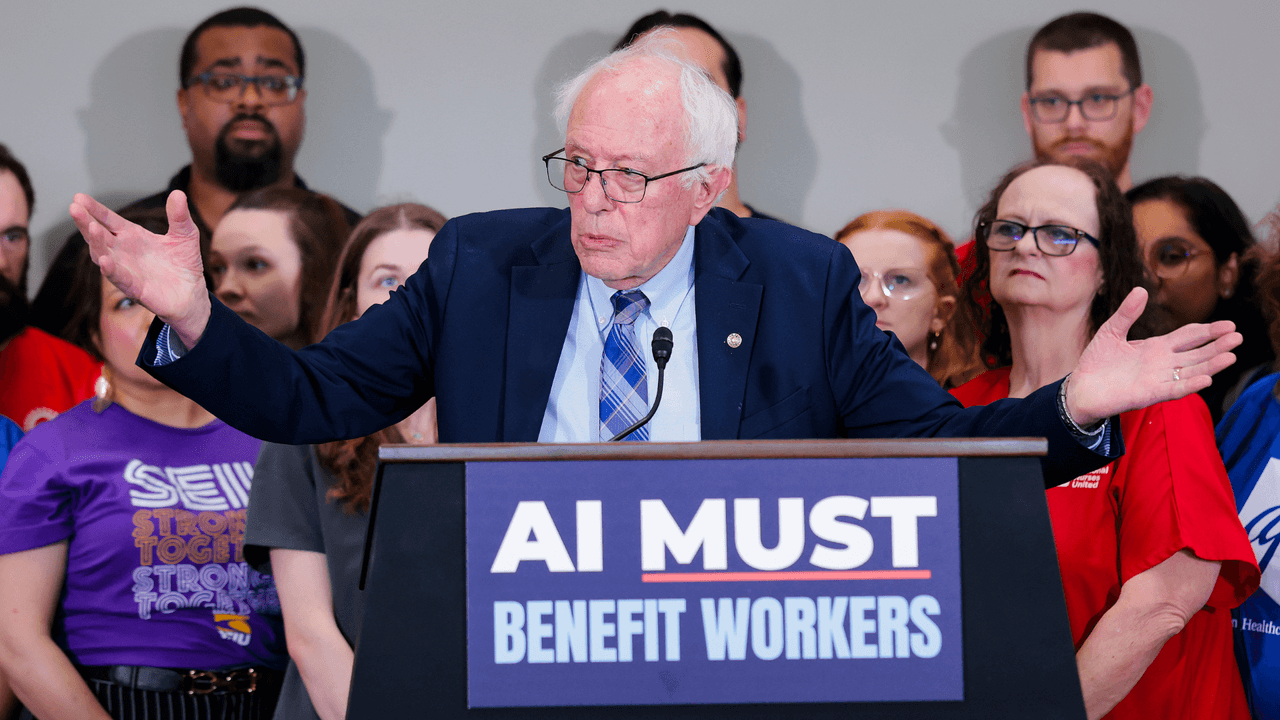
Bernie Sanders Introduces Landmark Bill for 50% Public Ownership of US AI Companies
Senator Bernie Sanders has introduced one of the most ambitious and controversial pieces of legislation in recent memory: a bill that would require the United States government to hold a 50% public ownership stake in major American artificial intelligence companies. Alongside that proposal comes a plan to distribute $1,000 dividends directly to American citizens, effectively giving everyday people a financial share in the profits generated by the rapidly expanding AI industry. The proposal has ignited a fierce national debate about who should benefit from the AI revolution — and how.
The timing is significant. Artificial intelligence is no longer a distant technological concept; it is already reshaping industries, eliminating certain jobs, driving corporate valuations into the trillions, and concentrating enormous economic power in the hands of a very small number of private corporations. Sanders' bill is a direct response to that reality.
What the Sanders AI Ownership Bill Actually Proposes
At its core, the Sanders legislation would establish a mechanism for the federal government to acquire a 50% ownership stake in the largest and most influential AI companies operating in the United States. In return for this public investment, American citizens would receive direct financial dividends — reportedly in the range of $1,000 per person — drawn from the profits these companies generate.
The philosophy behind the proposal echoes Sanders' long-standing democratic socialist principles: that transformative technologies developed with public research funding, public infrastructure, and the data generated by millions of ordinary Americans should not exclusively enrich a handful of billionaires and their shareholders. AI systems have been trained on publicly accessible information, built on decades of government-funded research, and deployed across public digital ecosystems. Sanders argues that the public is therefore owed a return on that implicit investment.
Key Pillars of the Proposed Legislation
- Mandatory 50% public ownership stake in major US-based AI corporations above a defined market threshold.
- Direct dividend payments of approximately $1,000 to American citizens funded by AI company profits.
- A framework for democratic oversight of how AI companies are developed and deployed.
- Provisions designed to prevent further monopolistic consolidation in the AI sector.
VP Vance Responds: Trump Supports Americans Having a Stake in AI — But Prefers 'Pre-Distribution'
In a notable moment of bipartisan overlap, Vice President JD Vance acknowledged that the Trump administration also supports the idea of giving the American people a meaningful stake in the future of artificial intelligence. However, Vance drew a sharp distinction between the Sanders approach and the administration's preferred framework, which he described as "pre-distribution" rather than redistribution through cash dividends.
Pre-distribution, as Vance framed it, refers to structuring the economy and AI development in such a way that ordinary Americans benefit directly before profits are extracted and redistributed. Rather than collecting AI revenues into a government fund and then handing out checks, the Trump-Vance vision leans toward policies that ensure workers, communities, and citizens gain equity, ownership, or wage growth as AI is integrated into the economy from the outset. This could involve incentivizing AI companies to offer broad employee ownership programs, structuring licensing agreements that benefit the public, or negotiating terms that embed worker and community benefits into AI development deals.
The distinction is philosophically meaningful. Sanders' model is closer to a sovereign wealth fund structure, where the state acts as a collective shareholder on behalf of all citizens. The Trump administration's pre-distribution model would aim to bake public benefit into the conditions of AI development itself, avoiding what Vance frames as dependency on government cash transfers.
Why This Debate Matters: The Economics of the AI Revolution
The stakes in this debate could not be higher. The AI industry is projected to contribute tens of trillions of dollars to the global economy over the next decade. In the United States, companies like OpenAI, Google DeepMind, Anthropic, and Meta AI are already valued at extraordinary levels, and that valuation is only expected to grow. The wealth generated by these platforms, however, is currently flowing almost entirely to private shareholders, venture capital firms, and a relatively small group of highly compensated technical workers.
Meanwhile, economists and labor researchers have raised serious concerns about AI's impact on employment. Automation driven by AI is expected to displace workers across sectors including logistics, customer service, legal research, journalism, healthcare administration, and more. If those displaced workers do not receive a share of the productivity gains AI creates, the result could be a dramatic widening of economic inequality — and a political crisis to match.
The Broader Policy Landscape
Sanders' bill and the Trump administration's response both reflect a growing political consensus — unusual in today's polarized environment — that the AI boom cannot simply be left to market forces alone. From progressives to populist conservatives, there is mounting agreement that ordinary Americans are entitled to benefit from technologies that are reshaping the country's economic foundation. The debate is not whether the public deserves a share, but how that share should be structured and delivered.
Public Reaction and Industry Pushback
Predictably, the tech industry has pushed back against the Sanders proposal. Major AI company executives and trade groups have argued that mandatory government ownership stakes would stifle innovation, deter private investment, and undermine the competitive position of US firms relative to Chinese AI developers. They contend that the best way to ensure public benefit is through taxation and targeted regulation, not ownership mandates.
Supporters of the bill, however, counter that the industry's track record of self-regulation has been poor, and that without structural intervention, the benefits of AI will remain inaccessible to the vast majority of Americans. Public polling has shown that large portions of the American population are open to the idea of public ownership or dividend programs tied to AI, particularly as concerns about job displacement grow.
Looking Ahead: Can Bipartisan AI Policy Actually Happen?
The convergence of Sanders and the Trump-Vance administration on the principle of public benefit from AI is a rare opening for potential bipartisan action. Whether that opening translates into actual legislation remains to be seen. The two sides differ significantly on method, and the political environment makes sustained cooperation difficult. Nevertheless, the fact that both ends of the political spectrum are now seriously debating how to give Americans a stake in the AI future represents a meaningful shift in the national conversation — one that is unlikely to fade as AI continues to reshape American life.